
Somewhere under the surface of your life, there’s a knowing that everything is okay.
What you’ve probably noticed.
Most people, when they look inside themselves, find worry under everything. A constant inner voice — neuroscience calls it the Narrative-Self — that runs commentary on their life, hunts for problems to solve, and weaves the story of who they are. For most people, it never fully quiets. You already know it doesn’t work that way for you — and someone here knew it before you read a word.
Reading this, something in you is already nodding — whether you have always been this way, or it shifted in an instant you can still point to. The voice doesn’t run the show the same way. There is something steady underneath. A quiet, immovable sense that, at the deepest level, everything is fundamentally okay, regardless of what is happening on the surface.
You may have tried to explain this to someone and given up, maybe even those closest to you. You may have assumed you were strange, because no one around you seemed to feel this way. Or that everyone else was just being dramatic. You may have gone looking for the words — in a tradition, a teacher, a book, a diagnosis — and found pieces but never quite the whole picture. Or maybe none of this was here at all until recently, and you’ve been quietly trying to make sense of what shifted, with no one to compare notes with. Either way: now, reading this, something in you feels seen.
You are not alone in this.
Research suggests fewer than half a percent of people live with this as their baseline. In the most literal sense, you’re one of the rarest kinds of people on the planet. There are no external markers. If you walked into a room of a hundred of your peers, you probably couldn’t pick out which of them share this with you. They’re there — in your audience, your industry, your inbox — quietly carrying the same questions, the same longing for understanding. You just haven’t had a way to find each other.
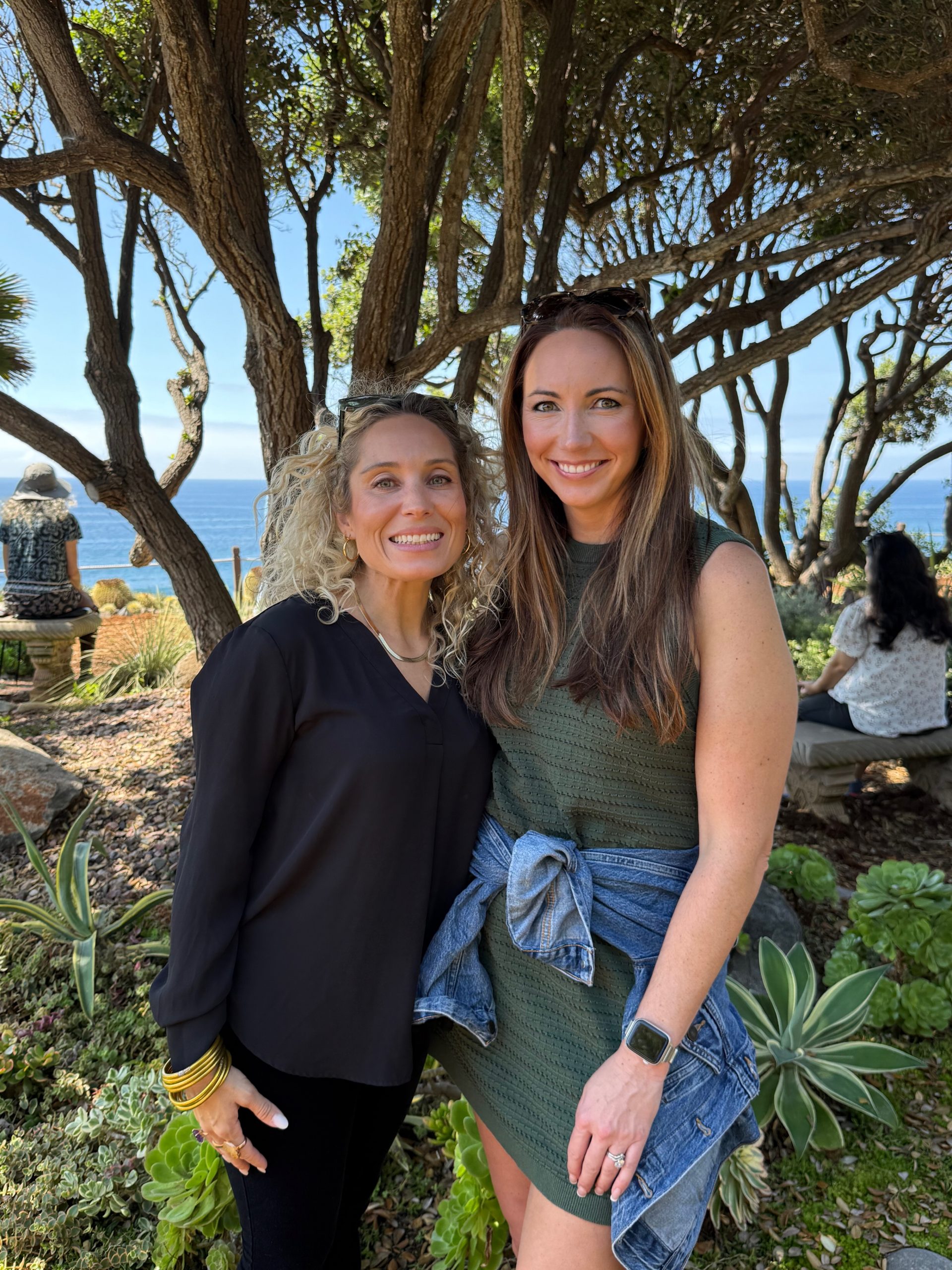
Melissa Tony Stires & Jocelyn Reyburn
THE FUNDAMENTAL WELLBEING FOUNDATION
— BY THE NUMBERS
25+
years of academic data
~0.5%
of the population, we estimate, already lives this way
6
continents of participants studied
——LANGUAGE
There is a word for this.
There’s a name for what we think you are: Finder. The closest word we have for an identity that’s real, that’s been documented across more than two decades of research, and that until very recently had no language attached to it at all.
We are being careful with this word for the same reason words like introvert and neurodivergent had to be introduced carefully into the culture. We want it to land for people who have felt misunderstood.
Being a Finder doesn’t make life problem-free. It doesn’t require a spiritual frame. It doesn’t look like anything in particular from the outside. Most Finders are ordinary people who go on with their ordinary lives — deeper, freer, more present, but still recognizably themselves. What changes is the ground you live from: peace becomes the baseline, not the goal — the place you return to, not the place you’re trying to reach. It’s what the research calls the primacy of peace.
Here is the contrast, plainly. For most people, peace isn’t even on the map — what they’re actually organized around is control. Control over outcomes, over how they’re perceived, over the future, over the people around them. The inner voice narrates everything — what just happened, what could happen, what should happen — and they take its commentary as the truth of who they are. All of it because life is uncertain, and control feels like the only ground there is.
For Finders, peace is the priority — and the sense that everything is okay, at the deepest level, regardless of what’s happening on the surface, is the ground. You may have always lived from this ground. You may have stepped onto it in a single moment that split your life in two. You may only be noticing it for the first time, right now. The inner voice still speaks. You just no longer mistake it for who you are. Difficulty still arrives. Sadness, frustration, fear, grief can all still come through. Some days the ground feels close and steady. Other days it feels distant, or newly unfamiliar, or harder to find than it was last week. None of that disqualifies you. That ground is what makes you a Finder.
For most Finders, reading an accurate description of themselves for the first time means they can stop translating, stop explaining, stop carrying it alone. If something like that’s happening for you as you read this, we know. We’ve watched that recognition land in many faces. We wrote this the way we did so you’d have somewhere to come, and feel met, when it did.
— CANNES LIONS
Bringing this conversation into the rooms where culture gets shaped.
The research, briefly.
Academically, what we’re describing is called Persistent (or Ongoing) Non-Symbolic Experience — PNSE or ONE for short. A team at the Center for the Study of Non-Symbolic Consciousness have been studying it since 2006, across thousands of participants on six continents. They have mapped it onto a framework we call the Fundamental Wellbeing Location Guide — a way of locating exactly where someone is along a continuum of Locations, each with its own texture, its own gifts, and its own questions.
There’s a free two-minute assessment that will tell you whether you’re in Fundamental Wellbeing, and exactly where on the Matrix you sit. Most Finders find the result surprisingly moving.
The science matters here for a reason. Something that’s been documented for twenty years, across thousands of participants, on six continents, isn’t opinion. It’s reality the culture hasn’t yet caught up to.
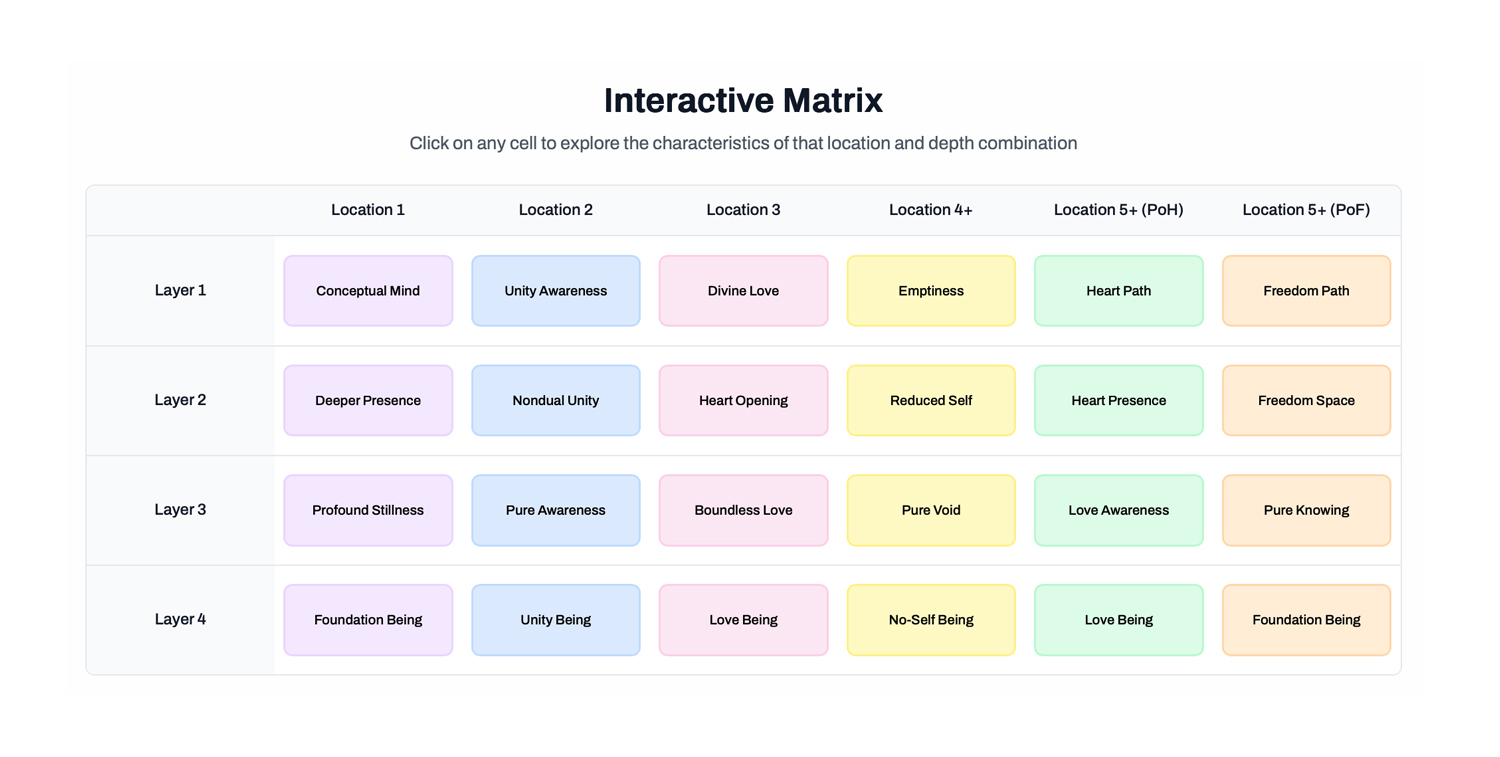
A glimpse of the Fundamental Wellbeing Location Guide. Take the free assessment to see exactly where you sit.
——THE BENEFITS
The life-changing difference of knowing you’re a Finder.
Knowing you’re a Finder doesn’t fix your life. What it does is name something you’ve already been living and make it usable, both for you and for the people around you.
01
You can prioritize peace deliberately, or trade it deliberately.
Most Finders have lived this way without realizing they were choosing. Peace was simply where they kept landing. The research is direct about what changes once you know: post-transition life is largely about a Finder’s relationship to this inner peace, and every choice ends up weighed, consciously or not, against its impact on it. Once you know, the weighing becomes conscious. You can lean toward peace on purpose: protect it, deepen it, make more room for it. And you can clearly name the places where you’re trading some of it for something else — whether that’s a relationship, a financial situation, a role you’ve taken on, or work that matters to you. The research calls these forced choices, and acknowledges that they lessen the peace a Finder could otherwise have. They become a clear-eyed decision instead of a drift.
02
You can recognize the cycles instead of being thrown by them.
Becoming a Finder kicks off a deconditioning process. Old patterns, identifications, and motivations unwind themselves over time, starting with an initial cycle that runs from a few months to about two years. If you’re inside that initial window right now, it’s one of the most beneficial times to actively work with your experience. If you’re learning this long after that window closed (which is the more common case), it still matters, because the cycles don’t end there. Further waves arrive at roughly three-year and seven-year intervals. Without the language for any of this, the cycles can get misread: a dip can be interpreted as “losing it,” a quiet phase as a plateau, an unexpected wave of old emotion as regression. In the research, they are well-mapped phases of an arc that keeps moving. Knowing what’s happening makes them gentler, less alarming, and easier to work with, regardless of when you arrive at understanding them.
03
Motivation can become a big issue for Finders.
Especially in the first two years, but also long after. When the Narrative-Self quiets, the goals it was driving quiet with it. The research calls this a neural recalibration: over a few months to about two years, old motivational pathways atrophy and new ones emerge. Without context, this gets misread as burnout, depression, or losing your edge. Even past that initial window, motivation can keep feeling off in ways that don’t fit a standard explanation. The honest work in either case is the same: getting clear on what you actually value, and letting that be what’s driving you, instead of leftover wiring from the old story. Most Finder decisions are driven by values, often invisibly. Knowing that turns values from background noise into something you can work with on purpose.
04
You can work with the experience instead of just having it.
Finder outcomes are not fixed at any stage. They are highly malleable, and the research consistently shows that Finders who engage actively with their experience land in noticeably different places than those who let it happen to them. If you’re newly transitioned, the first couple of years are the most malleable window of all, and what you do inside it tends to shape much of what follows. Working with the experience means having the language, the Matrix, frameworks for the cycles, a few practices for the parts that need them, and the company of other Finders who are doing the same.
Why You.
Most Finders spend their entire lives without language for what they live with. What changes when language finally arrives is harder to describe than it sounds. The experience doesn’t get better — it was already the unshakeable foundation. The experience becomes shareable.
You can locate yourself. You can find each other.
You can talk about it with people in your work, your family, your audience, without sounding like you’re claiming something. You’re just describing how you actually live.
For a Finder with a public voice, shareability matters more than you might realize. The way you describe your inner life — the words you use, the framing you give it — quietly teaches other people what is possible for them. When the language you have is both true and grounded in real research, you can offer it without it sounding like a pitch or a posture. You can just point.
The experience itself is also a spectrum. Finders describe a wide range of depths and textures — different ways of being inside the same underlying shift. An audience the size of yours almost certainly contains people across the whole landscape of it: quieter shifts, deeper ones, ones still arriving. Some of what they’re living, you’ll recognize from your own life. Some of it you won’t — and that’s the point. Knowing the full landscape, including the parts you don’t personally inhabit, lets you speak to what is actually happening for the people listening, not only to your own version of it.
We don’t reach out to many people this way. The fact that you’re reading this means someone on our team spent time with your work and recognized something underneath it — not your reach, not your credentials, but the quiet ground you carry and the effect it has on the people paying attention to you.
This is what we mean when we talk about helping the world arrive at a new identity language. Not a movement. Not a campaign. Just enough careful, accurate, lived-in language that the people who already are Finders can finally say so — and the people who aren’t yet can begin to know it’s a real direction they could be moving in.
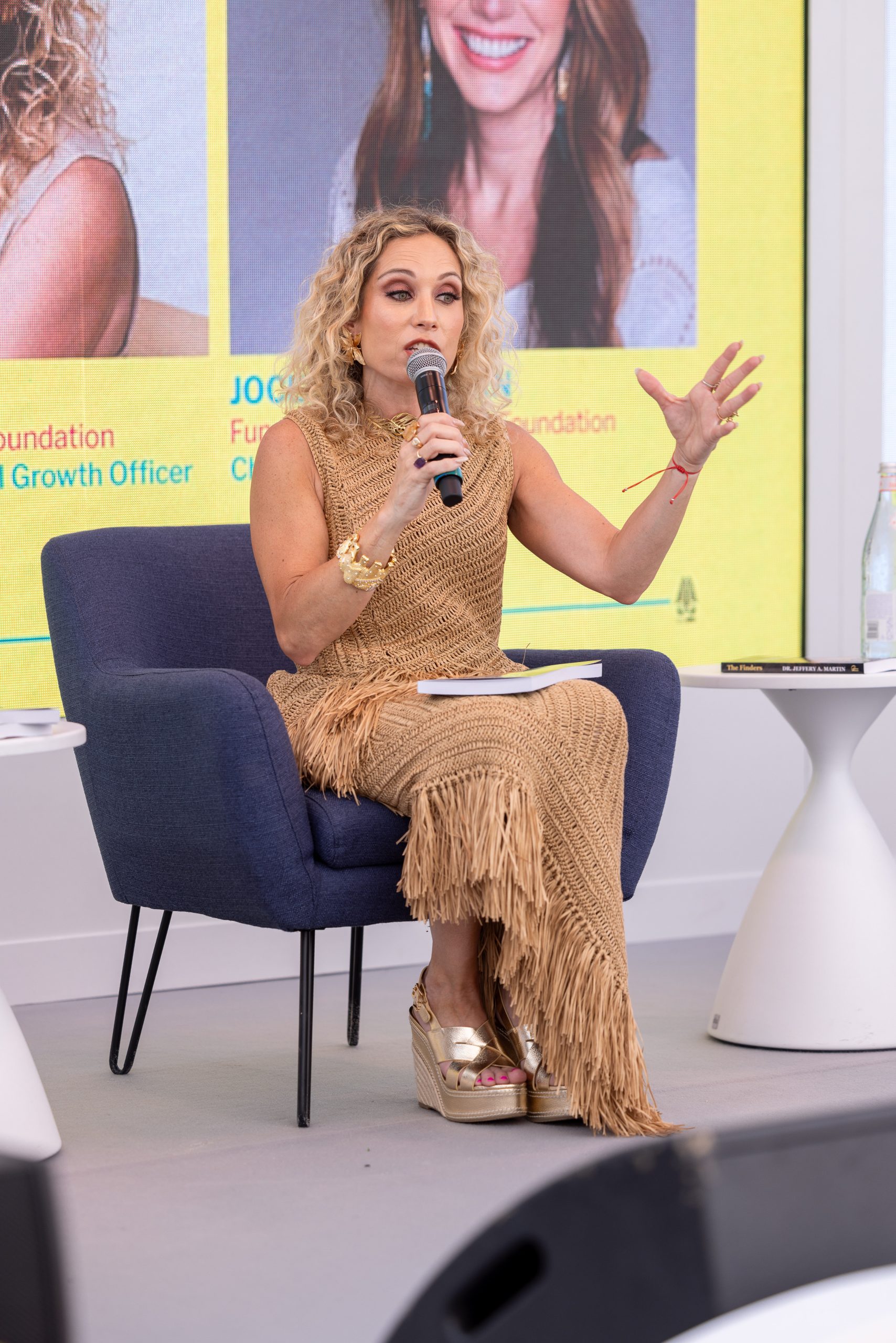
Melissa Tony Stires
CANNES LIONS 2025
——WHY NOW
Why any of this matters.
We don’t say this lightly: we believe the work of helping more humans access Fundamental Wellbeing may be one of the most important things happening on the planet right now. Not because it cures personal unhappiness, though it does. But because at scale, it changes what humans are capable of doing together.
Imagine a generation in which a meaningful percentage of leaders, parents, teachers, artists, founders, healers, and everyday people are operating from a baseline of inner steadiness. Not perfect. Not above difficulty. Just genuinely okay underneath. The arguments that fracture rooms today don’t fracture them the same way. The fear that runs the news cycle doesn’t run it. People can disagree without disintegrating. People can build without grasping. People can lead without performing. People can love without negotiating.
This is not a fantasy. Twenty years of research show the shift is real, replicable, and quietly available to far more people than have been told. The question is no longer whether what we’re describing exists. The question is whether enough of the right people can find their way to it — and find each other — in time for something larger to get to happen.
That something larger is what we’re working for. And people like you are who we’re working with.
The Foundation. The science. The community. All of it exists for one reason: to make this findable. The science is the foundation. The Finders are the proof. The voices of Finders with public reach — yours, possibly — are how this stops being a quiet, mostly hidden phenomenon and starts being a visible direction the species can move in.
— A PERSONAL NOTE
We think you’re one of us, and we’ve been looking for you for a long time.
——THE INVITATION
Why we’re writing to you.
If you’ve felt, anywhere along the way, that you were waiting to be found by people who actually understood you, we’d like you to know we’ve been waiting too.
There are a few ways we could actually get to know each other from here. None of them require you to change your work, your platform, your message, or your life in any way.
The simplest is just to write back. Reply to the email or message that brought you here and tell us what landed, what didn’t, where you recognized yourself, and what kinds of questions you have. That’s often where the real conversation begins. The options below are some other opportunities to connect with us and share your interest in this work.
A few shapes this could take.
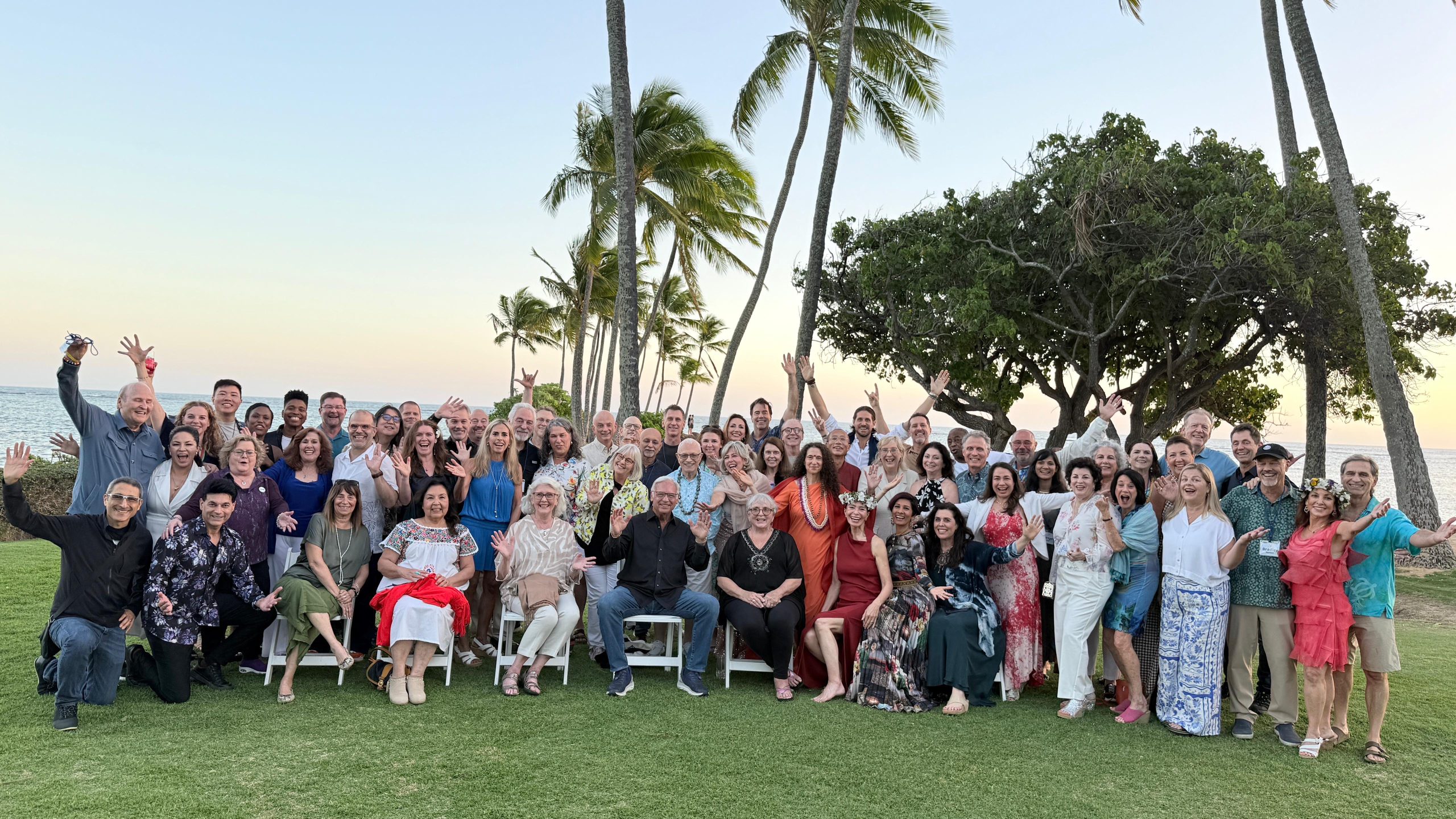
The Finders Collective.
The Finders Collective is the vision of Jocelyn Reyburn, the Foundation’s Chief Visionary Officer. Her work spans a lot of ground, but one thread that runs through the past decade is an expertise of building the rooms where culture gets shaped. Much of that came through her years working closely with Jack Canfield, one of the pioneering voices in personal development. Today she continues that work as a member and Co-Program Chair for the Transformational Leadership Council, one of the most influential rooms of conscious leaders in the world. As someone who has helped make those rooms what they are, she knows who belongs there, what makes them work, and what becomes possible when conscious leaders actually align and collaborate. The Finders Collective is what happens when she turns that experience toward Finders specifically — a room where the people quietly shaping the culture can finally sit across from one another and talk plainly about what they’re seeing, what they’re carrying, and what they’re moving in the world.
We believe something extraordinary happens when the Finders shaping the culture are gathered, supported, and inspired together. So we’re building this slowly, with intention, alongside the people inside it — because this is one we have to get right.
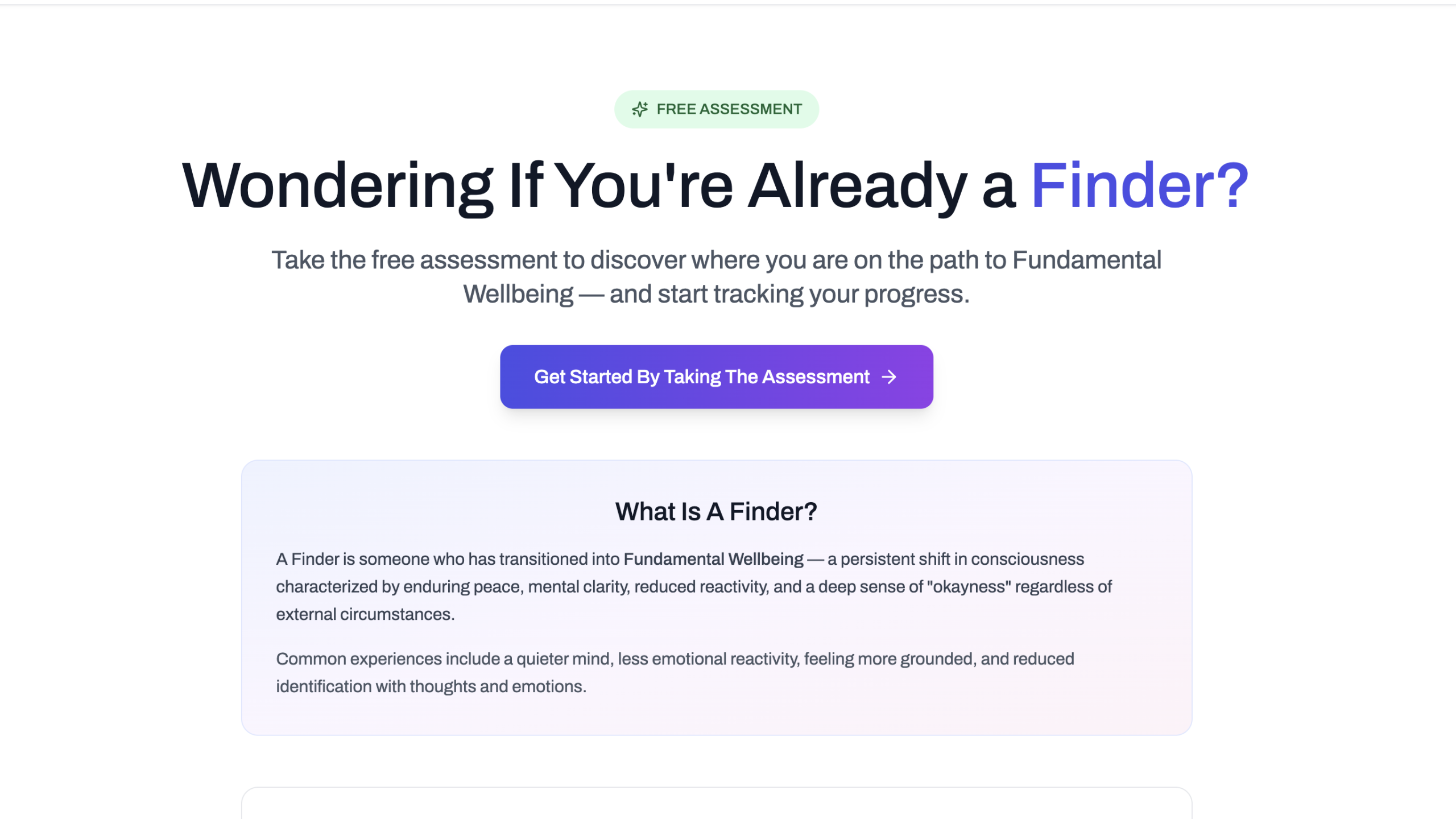
The free assessment.
If you haven’t already, the free two-minute assessment at thefinders.org is the fastest way to see where you are on the Fundamental Wellbeing Matrix. It’s definitely worth the time and provides so many insights. Once you take it, we’d love to just hear from you about what resonated for you.
— THE SIMPLEST WAY
Or just write.
If none of the above is quite right yet, or all of it feels too defined — write to us. Even “I just want to react to all of this” is a perfect message to send. Hearing how Finders respond to this work for the first time is, honestly, one of our favorite parts of doing it. You were already someone we were hoping would write back.
A nonprofit. Donor-funded. In service of Finders.
The Fundamental Wellbeing Foundation is a donor-funded nonprofit. Everything at thefinders.org and inside the app is completely free — including an AI Finders guide for all your personal questions, educational resources and programs for Finders, the interactive Fundamental Wellbeing Matrix, and so much more. Our focus is on finding Finders and making sure they’re supported.
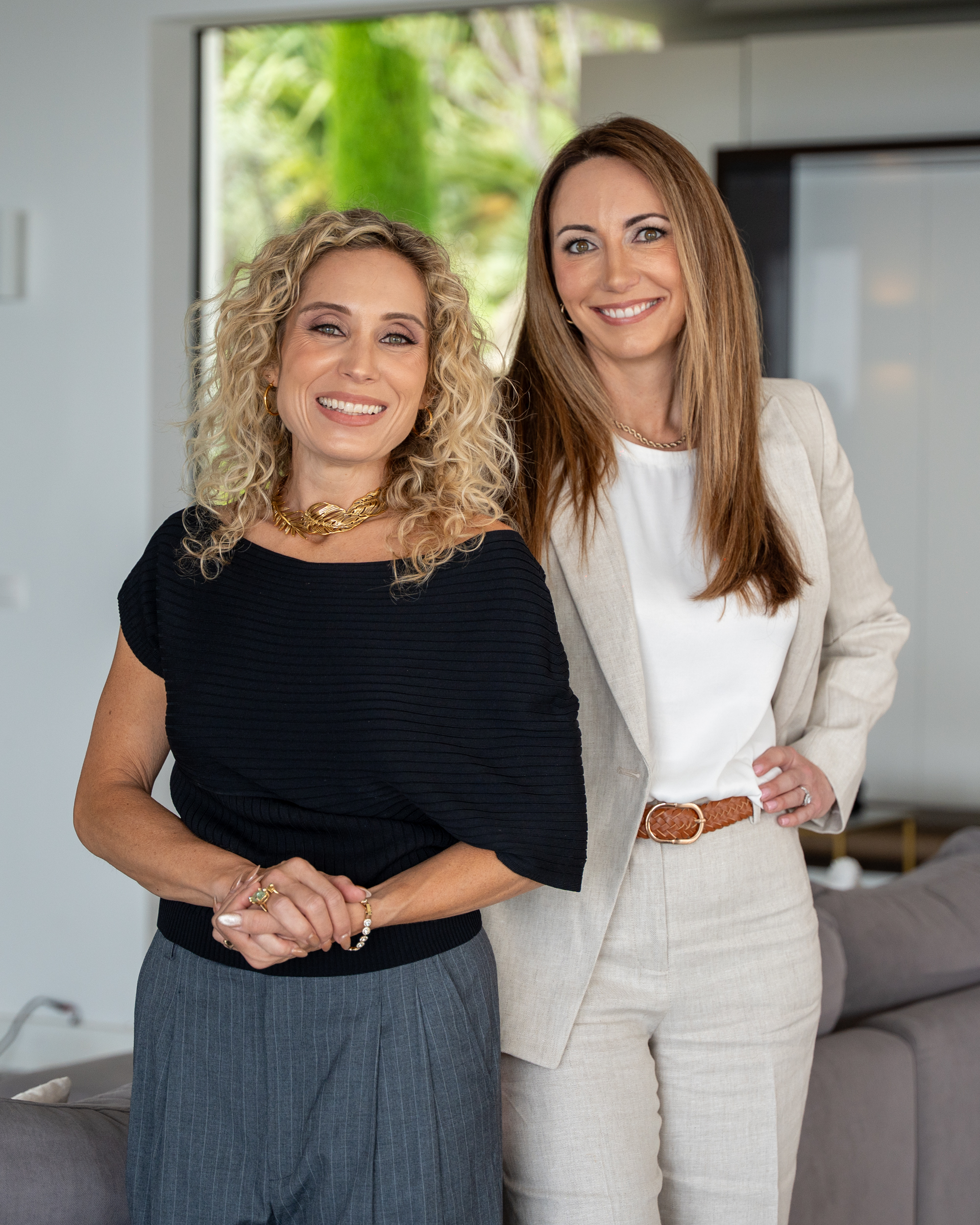
MELISSA TONY STIRES & JOCELYN REYBURN
Welcome home, Finder.
If this page found you, it’s because someone here saw something real. We’d rather have one true conversation with you than send a hundred polished emails.
What we’re really inviting you into is something larger than The Finders Collective or a contact form. We’re inviting you into a small but growing movement of people who carry an inner steadiness most of humanity has never been told is possible — and who are willing, in their own ways, to make it findable for others. You don’t have to know what your part in that looks like yet. What we do know is that it starts with people like you knowing you exist, knowing each other, and knowing that the science is finally here to back what you’ve quietly known all along.
Whenever you’re ready — even if it’s just to share a reaction or ask a question — we’re here.
— The Fundamental Wellbeing Foundation
— OPEN THE CONVERSATION
Write to us.
Tell us as much or as little as feels right. There’s no template, no required length, no perfect way to start. You were already the person we were hoping would reach out — this is just the part where you let us know you’re here.
This isn’t a sequence. There’s no funnel. Just us, and a small inbox we actually open.